Thursday, August 2, 2007

Interview: President of European Court of Human Rights Notes Necessity Searching Additional Ways of Simplifying Court Procedures


Interview: President of European Court of Human Rights Notes Necessity Searching Additional Ways of Simplifying Court Procedures

Trend’s interview with President of the European Court of Human Rights of the Council of Europe, Jean-Paul Costa.
http://news.trendaz.com/cgi-bin/readnews2.pl?newsId=966058&lang=EN

Question: The European Union has recently established an Agency for European Union on major rights. How could the activities of the new establishment affect the work of the European Court of Human Rights?

Answer: Well first of all I should stress that I have never seen efforts undertaken by the European Union in the field of human rights as being in some way in competition with the Council of Europe and its institutions. If we are serious about strengthening human rights protection throughout Europe then we must welcome initiatives that help to achieve this. The efforts of the European Union and the Council of Europe in this sphere are and must be complementary. In this context I am particularly encouraged by the decision at the recent EU summit in Brussels that the new reform treaty will include the obligation for the Union to accede to the European Convention on Human Rights. As to the Fundamental Rights Agency itself, I do not see it having any direct impact on the Court’s work, since its role is entirely different. It is not a judicial organ with competence to examine and adjudicate individual complaints against member States. It is more concerned with data collection, research, analysis and awareness-raising and this may help the Court and the Council of Europe (who will have a representative on the Agency’s management board) in the wider perspective of enhancing human rights protection generally.

Question: What are your views on the future of the Court and its mission in the general European law, with the consideration of developments ongoing worldwide, including Europe? Will the Court remain loyal to its principles, developed over more than 50 years?

Answer: My view is that the system set up by the European Convention on Human Rights has proved its worth and that no one has yet come up with a better system for international human rights protection. Indeed I would go further and say that the system remains an outstanding model for control mechanisms designed to supervise the implementation of international law. In many ways its mission has become even more important – as the world get smaller the need for effective international justice grows. But also if the challenges do change and the environment within which the system has to operate obviously evolves, the basic premise of the system remains as valid as it was in 1950. That is that the best way to secure a stable and peaceful Europe is the maintenance of democracy and the rule of law through a judicial mechanism of external scrutiny based on the principle of collective enforcement. Will the Court remain loyal to its principles? Well in one sense of course it will remain an independent judicial body, functioning impartially on the basis of the legal framework which defines its competence. Yet the Convention has never been wholly static; it is what we call a living instrument and this dynamic character is necessary to adapt its guarantees to changing society and technology. For example what was understood by private and family life in 1950 bears little resemblance to what is encompassed by this notion in 2007. Thus the Court has interpreted the Convention’s provisions quite extensively over the years. However, it does so with caution and it is in my view right that it should do so, within a subsidiary system, having close regard to what is or is not a matter of European consensus in terms of the legal recognition of moral, social and technological development.

Question: At the moment over 90,000 appeals are under the consideration of the European Court of Human Rights. Yet Protocol 14 has not been ratified. Ideas by the Sage Group are not approved fully, as well. What are your views on the future of the European Court of Human Rights?

Answer: I have repeatedly stressed the need for a rapid entry into force of Protocol No. 14 and I continue to urge the Russian Federation, the only Council of Europe State still to ratify the Protocol, to take the necessary steps as soon as possible. At the same time I think it is important that the Council of Europe takes forward the work of the Wise Persons without delay. We must look for additional ways for the Court to streamline its procedures. We have to make sure that the Court is able to devote enough time to producing well-reasoned judgments in respect of the most important cases, particularly those which have the most impact on national legal systems. But in the end it is only through more effective implementation at national level that we will be able to reduce the Court’s caseload to a more manageable level. When, as already happens in some Contracting States, national courts are ready to apply the Convention and the Convention case-law themselves, then the Strasbourg Court could become what it is designed to be, a Court of last resort, not instance.

Could you name the post-Soviet country which mostly appeals the Court and what are the major problems in the court system in counties in transition period?

It is no secret that State with the highest volume of incoming applications is the Russian Federation, which accounts for approximately 22% of all the applications pending before the Court. However, in terms of the number of applications per head of population several States have higher rates: for example Slovenia, Czech Republic, Latvia, Romania, Poland, Croatia …. I should also make clear that the number of applications brought against a State is not necessarily an indication of how well human rights are protected there. For one thing many applications will be declared inadmissible; for another the number of applications will often depend on how well known the Convention is generally within the State concerned and specifically within the legal community.

The sort of problem varies from State to State and there are some rather special situations which give rise to particular types of issue. Generally it takes time to adapt a legal system to the proper operation of the rule of law and it also requires adequate financing. Some problems are common to certain States. For instance the non-execution of final judicial decisions is an issue that we encounter in several states. Schemes introduced for the restitution of nationalised property have given rise to problems in some states. Some systems allowed for the quashing of final judgments on an appeal by the Prosecutor General, but this has mostly been resolved. Length of judicial proceedings is also a chronic problem in some States, but we also find this issue in the older democratic States.

Question: Do you plan to visit the South Caucasus countries, including Azerbaijan, in the near future?

Answer: I will be going to Armenia in the autumn and I plan to visit Azerbaijan next May.

UK challenges Strasbourg ban


UK challenges Strasbourg ban


Clare Dyer and Alan Travis
Thursday July 12, 2007
The Guardian

Britain launched an attempt at the European court of human rights yesterday to overturn an 11-year-old judgment by the court which bans the deportation of suspected terrorists to countries where they face a risk of torture or degrading treatment.
The government has been trying for two years to find a way of challenging the Strasbourg court's judgment in the 1996 Chahal case, which has frustrated its attempts to expel suspects to such countries as Tunisia and Algeria.
It was given permission to intervene in a case brought against the Netherlands by Mohammed Ramzy, a 22-year-old Algerian terror suspect, but that case has been held up by procedural delays.
However, yesterday the court's grand chamber of 17 judges heard Britain's arguments when it intervened in another case, brought against the Italian government by Nassim Saadi, 23, a suspected terrorist and brother of a suicide bomber. He was convicted of criminal conspiracy in Italy and given a 20-year sentence by a Tunisian military court in his absence for belonging to a terrorist organisation abroad and incitement to terrorism.
Italy obtained diplomatic assurances from Tunisia that he would not be tortured and could reopen the criminal case against him, but his lawyer, Sandro Clementi, told the court yesterday that it had strong evidence that torture was "a daily practice" in Tunisia.
Britain hopes to persuade the court to reconsider its judgment in the case of Karamjit Singh Chahal, a Sikh militant who successfully argued that he should not be sent back to India because he would face a real risk of inhumane treatment.

Strasbourg Court Sanctions Romania for Failure to Remedy Police Ill-Treatment of Romani Man

Strasbourg Court Sanctions Romania for Failure to Remedy Police Ill-Treatment of Romani Man
Bucurest, 27.7.2007, 16:04, (ERRC)

The European Court of Human Rights today delivered its judgment in the case of Cobzaru v. Romania concerning the beating of a Romani man by police officers while in custody in Mangalia, Romania, and the ensuing official investigation. The Court held that Romania is responsible for breaches of the prohibition of inhuman and degrading treatment (Article 3), the right to an effective remedy (Article 13) and the prohibition of discrimination (Article 14). The applicant was represented by Monica Macovei, a Bucharest-based lawyer, the Romanian Helsinki Committee, and the European Roma Rights Centre.
On 4 July 1997 after a domestic incident involving his partner and her relatives, the applicant went to the local police station asking for help. However, instead of offering help, two police officers brutally ill-treated him, and eventually released him after two hours. As a result of the beating, the applicant suffered from craniocerebral trauma and numerous bruises and haematoma all over his body. The official investigation into the assault ended with a decision of non-indictment, and was marked by numerous derogatory remarks on the part of the authorities in relation to the applicant's and the witnesses' Roma ethnicity.
In relation to the applicant's claims under Article 3, the Court noted the numerous shortcomings of the official investigation, and concluded that the Government did not satisfactorily establish that the applicant's injuries were caused otherwise than by the treatment inflicted on him while he was under police control, thus warranting a finding of both the substantive and the procedural aspects of Article 3.
The Court also established a violation of Article 13 of the Convention, since no effective investigation into the allegations brought by the applicant was carried out, and moreover, since the negative result of the criminal proceedings prevented the applicant from availing of any other domestic remedy.
The ruling on the applicant's Article 14 claim brings welcome clarification to the Court's case-law on the prohibition of discrimination. Firstly, the Court held that there was no evidence that the beating was motivated by racial hatred, and therefore did not find a substantive violation of Article 14. Secondly however, with regard to the procedural aspect of Article 14, the Court noted that even in the absence of prima facie plausible information to prove that the assault on the applicant was racially-motivated, the authorities were under an obligation to investigate a possible racist motive to the attack given the number and notoriety of such incidents in post communist Romania, and the general policies adopted by the Romanian government to combat discrimination against the Roma. Thirdly, the Court held that during the official investigation, a number of derogatory remarks were made in relation to the applicant's Roma origin, which disclosed the general discriminatory attitudes of the authorities, which in itself constituted discrimination contrary to Article 14.
The ERRC and APADOR consider that the judgment in the Cobzaru case is important for two reasons. Firstly, it highlights Romania's failure to provide effective protection to its Roma minority from harm meted out by police officers, as well as the widespread anti-Roma discrimination in the country. Secondly, Cobzaru further crystallizes the Court's case-law in the field of discrimination, principally by attaching significance to the general context of anti-Roma discrimination in Romania, and thus going beyond the particulars of the applicant's situation.

Read the full text of the judgments here: http://www.errc.org/db/02/6E/m0000026E.docc

ERRC

Strasbourg Fails to Reform Bulgaria’s Violent Police

Strasbourg Fails to Reform Bulgaria’s Violent Police

18 07 2007 Human Rights Court rulings fail to have much impact on law enforcers whose abuses go unpunished.

By Albena Shkodrova in Sofia

Several dozen people suffering from gas intoxication, three of them requiring medical treatment for rashes and pain in their eyes, and one for head injuries; this was the legacy of a visit by the Bulgarian police to the site of an unauthorized coal miners’ strike in the south a few days ago.
“When my officers carry out orders, I support them,” the interior minister, Rumen Petkov, commented after the event.
The minister justified the police brutality, saying the protesters had violated the local mayor’s orders concerning where to hold their strike. Workers from the Maritsa-Iztok mines had blocked the road between Svilengrad and Ruse as part of their protest against low wages.
Instead of decreasing as the country develops and integrates with the European Union, critics say excessive and unnecessary police violence not only remains a problem in Bulgaria but is getting worse.
They claim a mixture of low standards, controversial legislation and ineffective prosecution of police who abuse their position stand behind this trend.
“As soon as he took over, minister Petkov said the police will go to the limits of what the law allows,” a human rights lobbyist, Mihail Ekimdzhiev, says, referring to the treatment of the miners. “Instead of being condemned, his statement is becoming truer than ever.”
Through the years of its transition to democracy, Bulgaria has had a long and grim record of police brutality. Although the media have reported on hundreds of cases, many have gone unpunished.
Some were solved by the local courts, or reported to the European Court for Human Rights in Strasbourg, where a large proportion of the 112 sentences concerning Bulgaria since 1998 centre on police brutality.
Most involved the use of firearms against unarmed persons and beatings of suspects during interrogation. Most also concerned individuals rather than groups.
However, the case with the group of miners is not without precedent. During routine security checks last June, police from a special unit carried out a mass beating of clubbers in the resort of Varna, according to the Bulgarian Helsinki Committee. Several victims of the raid told the committee that while the police beat them, they forced them to bark like dogs.
Experts say one reason why police brutality continues to flourish is that so many of these kinds of abuse remain unpunished.
In a number of cases, the Strasbourg court found Bulgaria guilty of mismanaging the investigations, apparently aiming to cover up rather than establish the true sequence of events.
The authorities dispute this. Sofia’s Military Court of Appeal, for example, has released statistics noting that 55 Bulgarian police were sued for injuries in the last two years alone while 34 were sentenced.
But the Helsinki Committee remains skeptical. They say their research show relatively few police face any penalty for abuse, “especially when the victims belong to the Roma minority.”
One case on their files concerns a Roma man who was shot dead in the head by a policeman in March 2004.
Plovdiv’s Military Prosecution office then allegedly tried to stop an investigation on the grounds that the firearm was used legally. The courts have repeatedly returned the case for further investigation.
Another case involves a Roma man shot dead by a policeman in September 2004. In this case also, the Sofia Military Prosecutors office have tried to block any investigation, while the Sofia courts have pushed it forward.
In 2006, judges ruled: “It is clear that the Sofia Military Prosecutors have aimed at stopping the case without making any serious efforts to establish the truth.” In spite of this sharply worded court resolution, no indictment of the policeman was filed to date.
Apart from the fact that police crimes often remain unpunished, critics say a culture of brutality is encouraged by the ambiguities in the ministry of interior’s code of conduct.
“It does not clearly state the terms and conditions concerning the use of fire arms,” Ekimdzhiev says of the code on the website of his organization, Eurorights. “The law allows for the use of guns against unarmed persons who do not … [even] threaten anyone.”
As an example, he quotes the case of “Nachova versus the state”, which ended with a verdict against Bulgaria in Strasbourg in 2005. In it military police shot two Roma boys dead after they absconded from military service and tried to flee the patrol following them.
The Helsinki Committee agrees. “Many cases of lethal use of fire guns by police in the last years remained ineffectively investigated and were closed with the conclusion that the weapons were used legally,” it reported earlier this year.
“In at least one case a man has lost his life under dubious circumstances, after ending in police hands,” it added.
As the continuing pattern of police brutality over recent years is quite clear, the issue is whether the Strasbourg court will manage to force the Bulgarian police to change its practices and culture.
Snezhana Botusharova, a judge at the court for nine years, says decisions made by the court have helped to modify local legislation. She says the penal code has been changed as a consequence of some verdicts in Strasbourg, for example.
But not everyone agrees that the court’s sentences concerning Bulgaria have had a significant effect on the national judiciary. “We think it’s the other way around,” Yuliana Metodieva of the Bulgarian Helsinki Committee, says. “Our researches show that concerning police brutality, practice is regressing.”
Apart from general political indifference to the problem at a national level, one other factor diminishes the effect of Strasbourg Court’s decisions; when verdicts involve compensation, those are paid out of the state budget. No financial responsibility is sought from those who actually inflicted the damage.
“The government does what is easiest,” Ekimdzhiev says. “It pays compensations with taxpayers’ money and neither analyses the judicial problem which brought the verdict, nor acts adequately to solve it.”

Albena Shkodrova is BIRN`s Bulgaria country director. Balkan Insight is BIRN`s online publication.

Poland's Kaczynski Wants to Stop German Land Claims


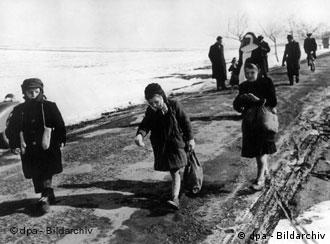
Expellees from Poland arrive in Germany. Many Germans expellees left houses behind


Poland's Kaczynski Wants to Stop German Land Claims
dwelle

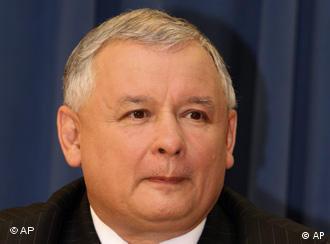
Poland's Prime Minister Jaroslaw Kaczynski wants to close loopholes that allow German expellees to reclaim land lost after World War II in Poland. Poles should not have to worry about losing their property, he said.
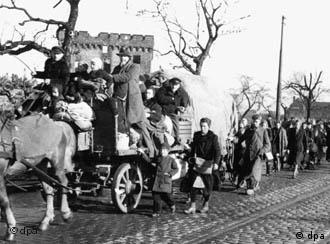
Millions of ethnic Germans found themselves living in Poland after World War II when the Potsdam Agreement in 1945 expanded Poland's border 200 kilometers (124 miles) west, and many of them were expelled from the country, leaving their homes and land behind. The property belonging to the expellees was given to Poles who themselves were made homeless by shifting borders after parts of eastern Poland were annexed to the Soviet Union.
All told, 12 million to 14 million ethnic Germans were victims of mass expulsions from Poland, the Czech Republic and other countries in Eastern Europe. Many are represented by groups like the Prussian Trust, which has brought compensation claims against Poland to the European Court of Human Rights in Strasbourg.
The German government does not support lawsuits by its citizens and Germany dropped all territorial claims in Poland as part of a 1990 treaty, but the issue is one of many, including a German-Russian gas pipeline planned to be built across the Baltic Sea, that has made for tense relations between Warsaw and Berlin.
Some Germans have regained property
Cases have been brought by Germans who left Poland as late as the 1970s, fleeing the then-communist country. Some Germans who were expelled recently launched attempts to regain their property. A group of more than 20 Germans or their descendants have filed property claims with the Strasbourg court. Some have also won cases in the Polish civil courts.


Prime Minister Jaroslaw Kaczynski at a news conference said he wants legal security for Poles

Kaczynski said he wants the property rights matter settled "once and for all."
"Those [Poles] who took over property in good faith, as a result of events tied to Germans leaving Poland, even those so-called late-departures, must have 100 percent certainty that their situation is secure and nothing threatens them," he said Thursday.
Poles resent property claims
Polish citizens shouldn't have to worry "that somebody could come take his land away because sometime in the 1970s it belonged to someone else," Kaczynski added.
The cases have also caused uncertainty and resentment among Poles who have settled the area and Polish politicians have accused Germany of trying to rewrite history by portraying Germans as the victims of Polish expulsions.
Kaczynski visited the northern town of Narty on Thursday and spoke with residents there. He held a press conference from the yard of a red brick house that belongs to Zdzislaw and Lucja Lunskis. They are appealing a recent Polish court decision that would return their house to its previous German owners.
Kaczynski wants to close these "loopholes" by updating the register and transforming lease agreements into deeds.
"We will aim to bring changes in the law which in the end will prevent these types of decisions," Kaczynski said.
Domestic political issue
Kaczynski was critical of several recent Polish court decisions which sided with German landowners.


German expellees head west in carts and by foot after World War II

"It is clear that the courts' responsibility is to act in line with Poland's national interest," Kaczynski said.
While a handful Polish homeowners have been forced to give up their property, the issue could become a political tool for Kaczynski's Law and Justice Party to show its patriotism in a possible election where it will compete with its junior coalition party, the League of Polish Families.
The land claims are one of many issues which have caused tension between Poland and Germany. Relations between the two are the worst in years, with Kaczynski using Poland's suffering under the Nazis as leverage during EU treaty negotiations last month.
Article based on news reports (th)

Judge Seeks to Slow Appeals to Strasbourg

Judge Seeks to Slow Appeals to Strasbourg

The Associated Press

MOSCOW — The Constitutional Court’s chairman is calling for legislation barring Russian citizens from appealing to the European Court of Human Rights before exhausting all domestic legal possibilities.
The comments by Valery Zorkin on Saturday came just days after the European court handed down the latest verdict against Russia stemming from human rights abuses in Chechnya. His call is also the latest criticism of the court to be voiced by senior officials, who are incensed with growing number of appeals by Russians and the growing number of cases that Russia is losing.
Zorkin said the European court was essentially subverting Russia’s judicial system by allowing appeals before Russia’s top courts — the Supreme and Constitutional courts — had heard the cases.
“This also cuts off the summit of the judiciary pyramid in our country,” Zorkin said, Interfax reported.
“By replacing the Supreme and Arbitration courts, and partially the Constitutional Court, the European court, which is a supranational body, plays the role of a national tier of judiciary, which is at odds with its nature and tasks,” he said. He also suggested that procedures at Russia’s top courts be simplified.
Dozens of rights cases are pending before the Strasbourg-based court, and Moscow has been ordered to pay hundreds of thousands of euros to victims of the Chechen conflict. Human rights activists say the fact that Russia accounts for the largest number cases filed to the European court is an indicator of Russians’ frustration with domestic courts.
On Thursday, meanwhile, the court ruled that Russian authorities were responsible for the presumed killing of a former speaker of the Chechen parliament in 2000, and ordered Moscow to pay his mother $54,000 in damages.
The European court’s chairman in May urged Russia to approve reforms of the court that the parliament has blocked. Russia is the only member of the 46-nation Council of Europe, the European rights watchdog that runs the court, that has not yet ratified the reforms so that they can come into force.

Konevska-Trajkovska to visit Strasbourg


Konevska-Trajkovska to visit Strasbourg

Thursday, 05 July 2007
mrt.com.mk

konevska_Deputy Prime Minister in charge of European Integration Gabriela Konevska-Trajkovska will visit the Council of Europe in Strasbourg on July 5. Konevska-Trajkovska will take part in the Summer University for Democracy, at the special round-table examining the question "50 Years after the Treaties of Rome: Where is the European Project?"
In the course of the visit, Macedonian Deputy Prime Minister will hold bilateral meetings with the participants.
Over 600 participants from Schools of political studies in 15 European countries will gather in Strasbourg from 2 to 6 July for the second Summer University for Democracy, organized by the Council of Europe.
Council of Europe Secretary General Terry Davis opened the Summer University, whose theme is “Projects for Europe". Council of Europe Human Rights Commissioner Thomas Hammarberg, Parliamentary Assembly Vice President Göran Lindblad and Philippe Richert, Vice-Chairman of the French Senate, counted among speakers at the opening.